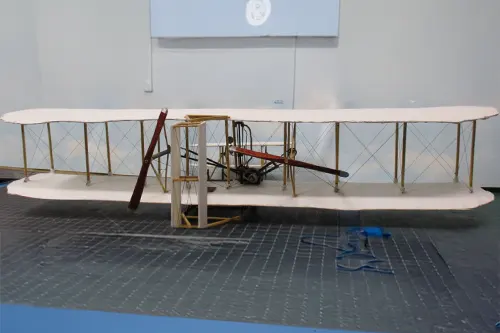
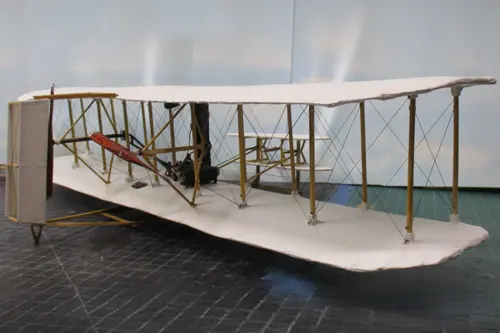
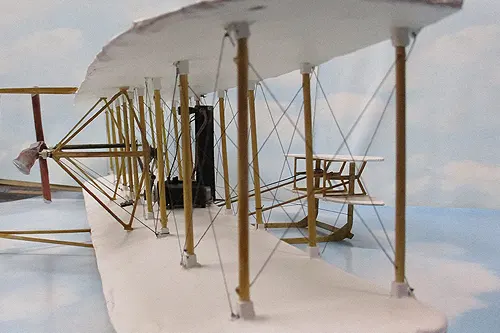
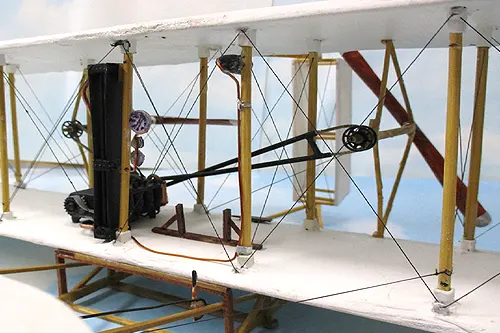
This scratch-built model of the Wright Flyer has a 24-inch wingspan.
The Wright Flyer (also known as Kitty Hawk, Flyer I, or the 1903 Flyer) achieved the first sustained, controlled, powered flight of a manned heavier-than-air aircraft on December 17, 1903. Designed and flown by brothers Orville and Wilbur Wright, the aircraft marked the beginning of the pioneer era of aviation and a defining milestone in human flight.
The Wright Flyer was a single-seat biplane featuring anhedral (drooping) wings, a forward-mounted double elevator (canard), and a rear double rudder. It was powered by a 12-horsepower (9-kilowatt) gasoline engine driving two pusher propellers. Control was achieved through wing warping, a system that provided lateral control but made the aircraft inherently unstable and challenging to fly by modern standards.
The Wright brothers completed four flights at Kitty Hawk, North Carolina, in an area now part of Kill Devil Hills, approximately four miles south of the original settlement. The longest flight covered 852 feet (260 meters) on its fourth attempt before the aircraft was damaged during landing and subsequently destroyed when strong gusts overturned it shortly afterward.
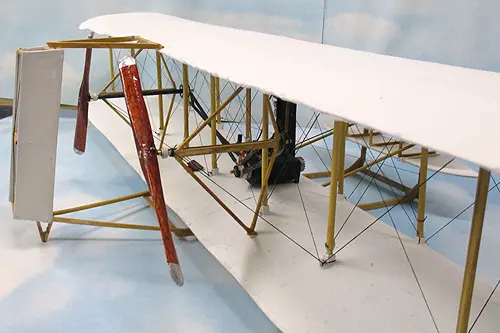
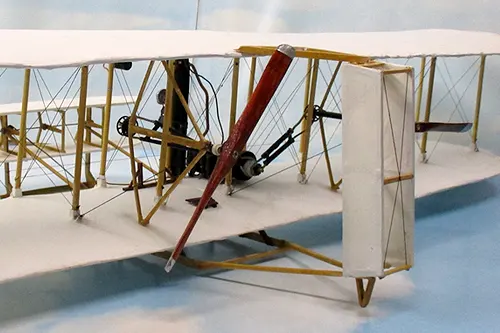
Note the intricate rigging within the wings of the aircraft, highlighting the structural bracing and tensioned wire framework essential to the Wright Flyer’s lightweight construction and early flight stability.
This is a highly detailed, scale replica of the Wright Flyer, capturing the form, structure, and engineering characteristics of the original 1903 aircraft.
A close-up view of the Wright Flyer’s vertical stabilizers, highlighting the twin rudder design and the lightweight structural framework characteristic of early aviation construction.
This view provides a clear overall look at the aircraft model on the ground, showing its full form and ground stance in context.
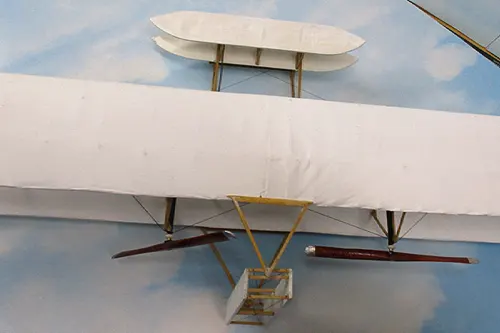
An overhead view of the Wright Flyer, showing the full wing configuration, structural layout, and overall proportions of the aircraft from above.
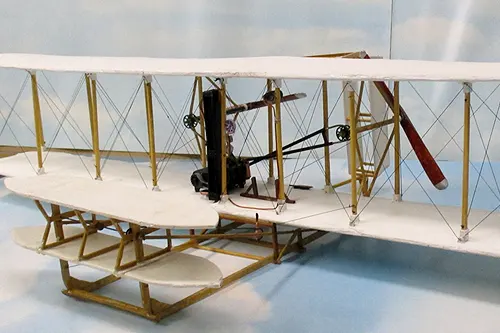
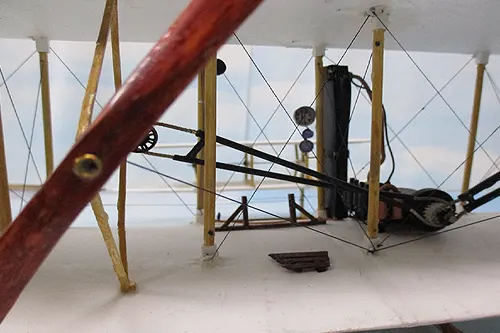
The propellers were powered by the engine through elongated bicycle-style chains, a key feature of the Wright Flyer’s transmission system that transferred power to the twin propellers.
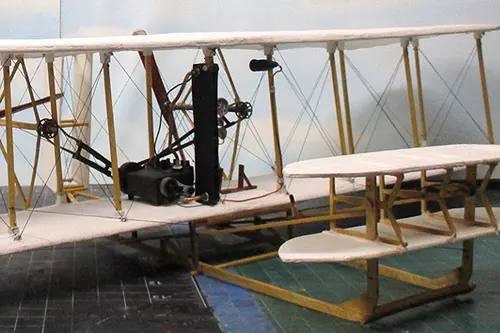
A view of the powerplant and the forward horizontal control surfaces, highlighting the engine installation and canard elevator that provided pitch control on the Wright Flyer.
Climb aboard and imagine taking to the sky for the very first time in the Wright Flyer, experiencing the pioneering spirit of early powered flight.
The small vertical sticks at the center of the lower wing serve as the pilot’s primary flight controls, used to manage wing warping and directional control of the Wright Flyer.