Research indicates that the ship’s cargo was recovered at the site, lending support to the interpretation that earlier reports of piracy are likely incorrect. It is more probable that the vessel was an older, heavily used ship that sank during a storm. The wreck was discovered in approximately 100 feet of water in 1965, just off the coast.
Greek fishermen in the region are well known for sponge harvesting, a traditional trade involving the collection of natural sea sponges for commercial use. Sponges are diverse marine organisms, with more than 200 known species found in oceans worldwide, including in deep-sea environments at depths exceeding 500 meters. Some species are believed to have lifespans of more than 200 years. They are filter feeders, drawing water through their porous bodies to extract nutrients.
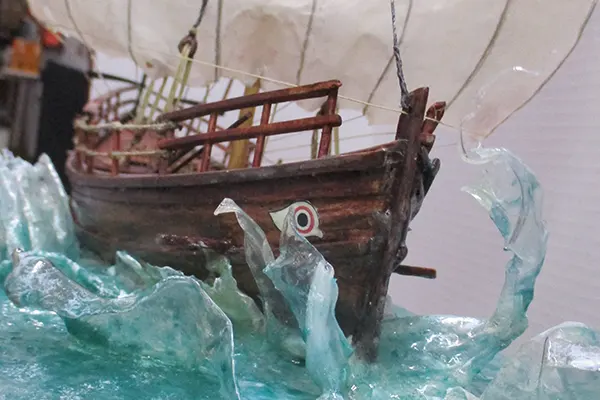
The Kyrenia is shown here under full sail, with waves breaking against her bow and cascading along the sides of the hull, capturing the vessel in motion at sea.
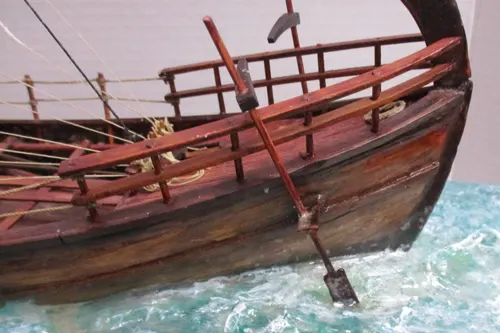
Here we see the stern of the vessel, along with much of the sail rigging, highlighting the structure and detail of the Kyrenia’s aft section.
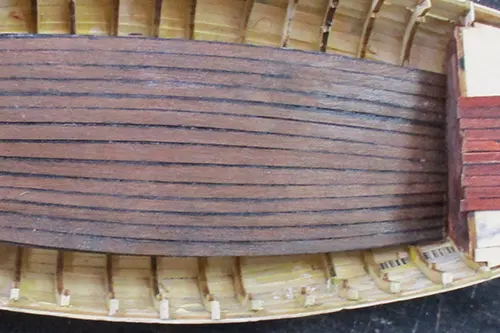
Here is a look at some of Rich’s handcrafted wood decking integrated within the wooden framework of the hull, surrounding the deck area and highlighting the construction detail and craftsmanship throughout the ship model.
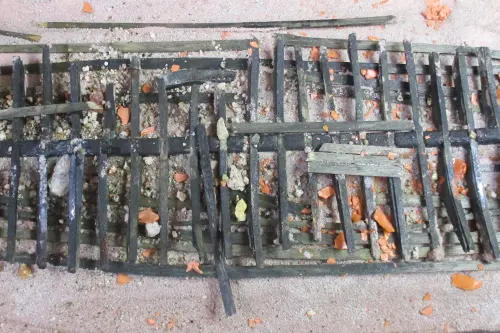
This model depicts a historical shipwreck site discovered on the seafloor, with the reconstruction showing the original vessel in its presumed original condition sailing above the submerged wreckage below. The composition contrasts the ship’s former appearance with the remains resting on the ocean floor, illustrating both its history and final resting place.