The Blériot XI is a French aircraft from the pioneer era of aviation and remains one of the most historically significant early airplanes. Designed and built by Louis Blériot, the aircraft achieved global recognition on July 25, 1909, when Blériot completed the first successful flight across the English Channel in a heavier-than-air aircraft. This milestone marked a turning point in aviation history, demonstrating the practical potential of powered flight and securing Blériot’s legacy as a leading aviation innovator.
The Channel crossing was widely regarded as one of the defining achievements of early aviation. It earned Blériot international acclaim and established the commercial viability of his aircraft manufacturing business. Public reaction underscored the importance of the accomplishment. The British newspaper The Daily Express famously reported the event under the headline “Britain Is No Longer an Island,” reflecting widespread recognition of aviation’s strategic and cultural implications.
The Blériot XI was produced in both single-seat and two-seat configurations and was powered by a range of early aircraft engines. It saw extensive use in flight training, competitive aviation events, and early military applications. Several countries adopted military variants of the aircraft, and it remained in service through the early stages of World War I, which began in 1914.
Today, the Blériot XI is recognized as one of the most iconic aircraft of the early twentieth century. Two restored, original examples, located in the United Kingdom and the United States, are widely believed to be the oldest airworthy aircraft still capable of flight.
This particular model was constructed primarily from a kit commissioned by a private collector. Although the finished model is highly detailed and historically accurate, the project presented significant challenges. The kit lacked complete components and provided limited assembly guidance. As a result, the builder, Rich, fabricated numerous parts from scratch and implemented modifications to improve historical accuracy and structural integrity, bringing the model closer to the original Blériot XI design.
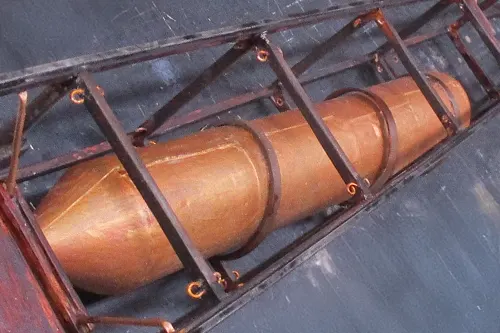
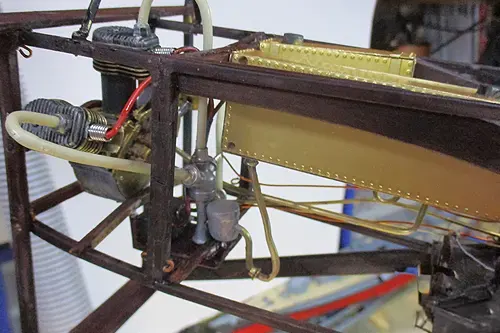
This image shows the copper-wrapped fuel tank of the Blériot XI, highlighting the aircraft’s fuel storage system and its integration within the fuselage structure.
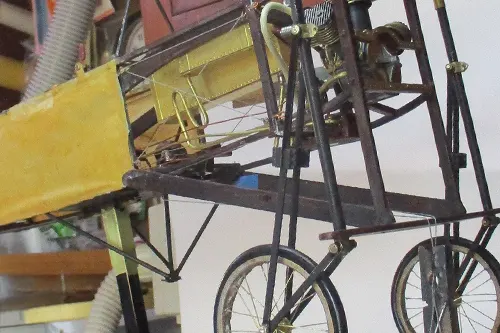
A close-up view of the forward fuselage and landing gear of the Blériot XI, highlighting the structural details and integration of the aircraft’s undercarriage with the main frame.
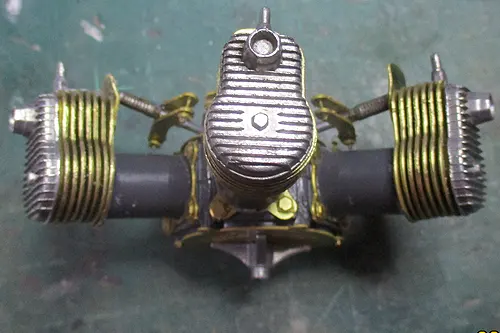
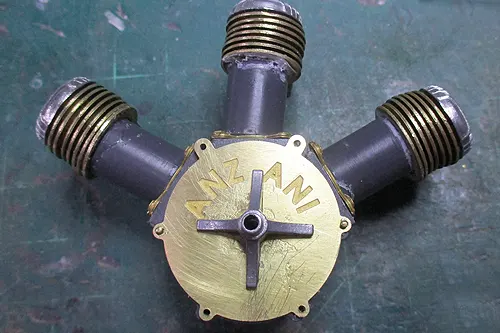
This image provides a detailed view of the air-cooling fins atop the engine cylinders, highlighting the finely rendered mechanical detail of the Blériot XI model’s powerplant.
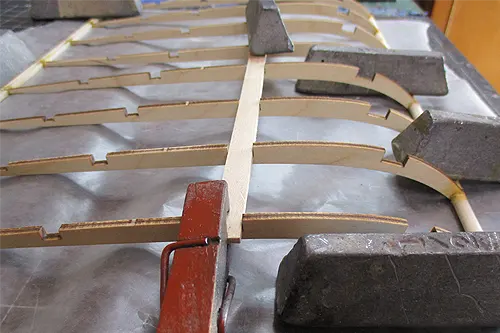
A close view of the early stages of wing spar construction for the Blériot XI, illustrating the initial assembly of the primary structural elements of the wings.
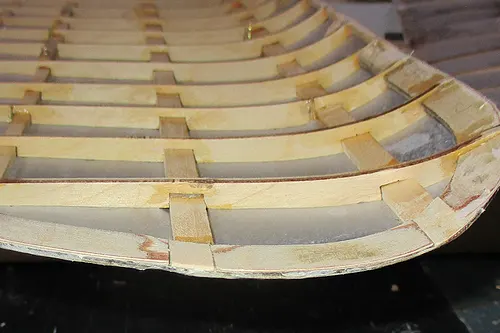
This image highlights the pronounced airfoil curvature of the wing, emphasizing the aerodynamic shaping characteristic of the Blériot XI design.
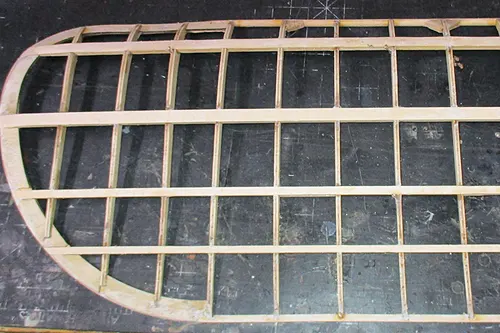
A more complete view of the upper wing framework of the Blériot XI, showing the structural layout and bracing that define the wing’s overall shape.
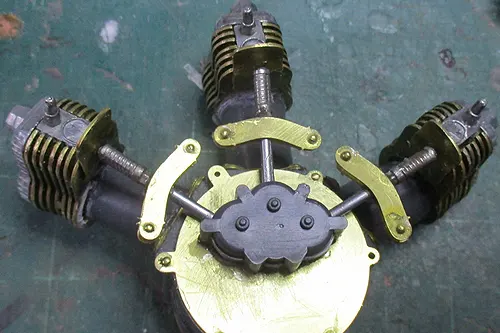
A view of the front of the engine during construction on the Blériot XI model, showing early assembly and component placement within the forward airframe.
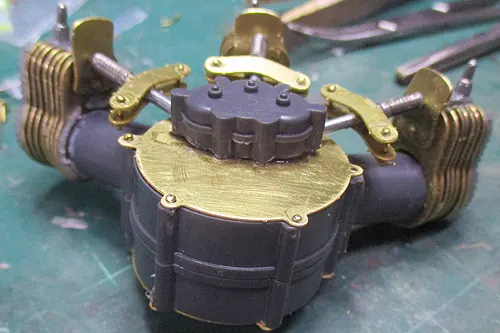
A close view of the firewall side of the air-cooled engine on the Blériot XI model.
Most of the preformed holes, in both plastic and brass components, required enlargement to properly fit the supplied pins used as bolts, ensuring accurate assembly and improved structural alignment.
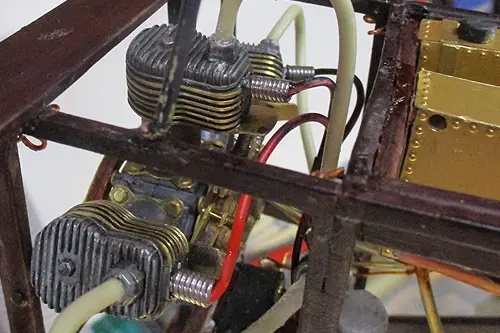
This image shows the engine mounted in the forward portion of the Blériot XI airframe, highlighting its integration within the aircraft’s structural framework.
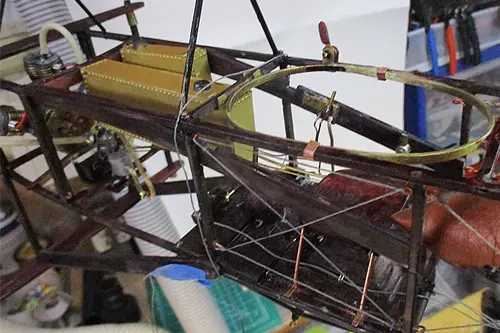
A close view of the framework surrounding the cockpit and midsection of the Blériot XI fuselage, highlighting the structural elements that define the aircraft’s lightweight design and early aviation engineering.
A close view of the framework surrounding the cockpit and midsection of the Blériot XI fuselage, emphasizing the lightweight structure and construction typical of early aviation design.
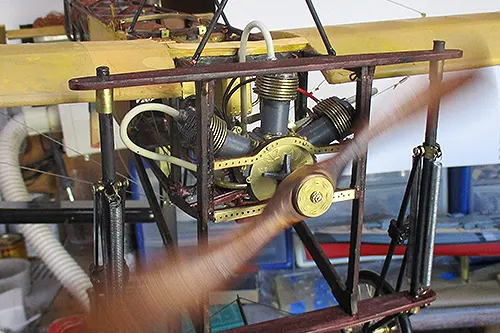
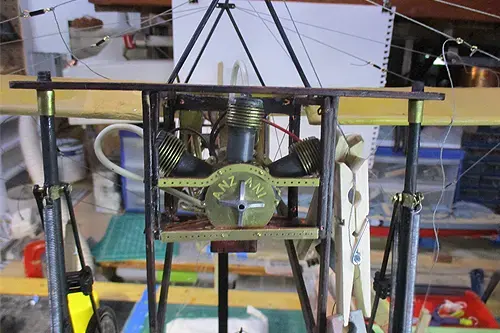
A head-on view of the engine mounted within the Blériot XI aircraft, highlighting the configuration and placement of the powerplant within the airframe.
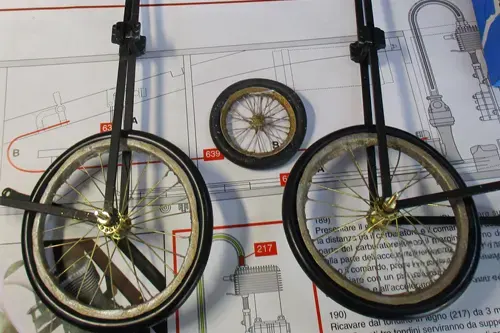
A close view of the spoke wheels on the Blériot XI landing gear. Each spoke was individually fabricated by hand, and every wheel was carefully laced with metal spokes to replicate the structure and appearance of the original aircraft.
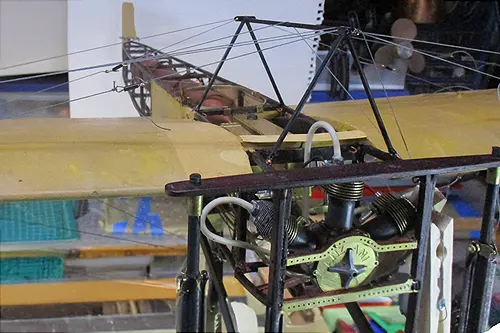
This view shows the forward area of the Blériot XI aircraft frame, including the engine mount and landing gear, highlighting key structural components of the early aviation design.
A view along the top centerline of the Blériot XI during construction, with the wings attached, illustrating the aircraft’s alignment and structural assembly.
A close view of Rich’s scratchbuilt balsa wood pilot figure for the Blériot XI model, shown prior to final detailing and completion.
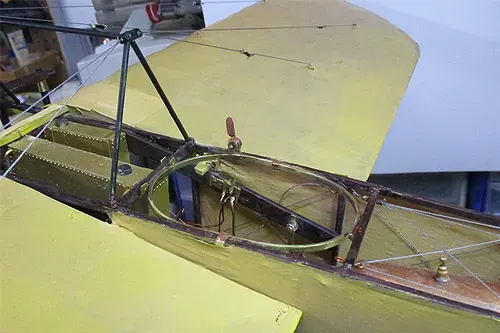
A clear view of the nearly complete Blériot XI cockpit, with the wings attached and the covered sections of the fuselage in place, highlighting the aircraft’s developing structure and finish.
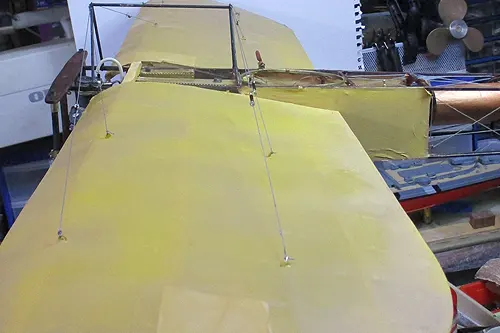
A view across the wingspan of the Blériot XI, highlighting the full breadth of the aircraft’s wing structure and its lightweight construction.
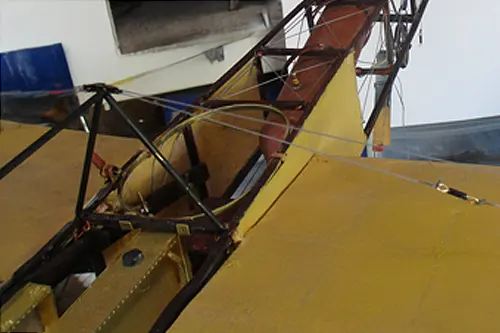
A detailed view of the rigging surrounding the cockpit and forward fuselage of the Blériot XI, illustrating the network of tensioned wires that supports and stabilizes the aircraft’s lightweight structure.
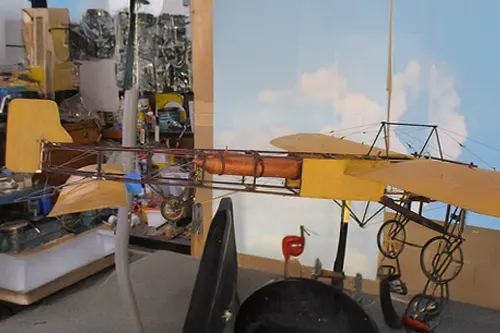
In this final image, a profile view shows the nearly completed Blériot XI model, highlighting the aircraft’s full length and overall form as assembly approaches completion.