
Portfolio - AWACS
USAF AWACS AIRCRAFT
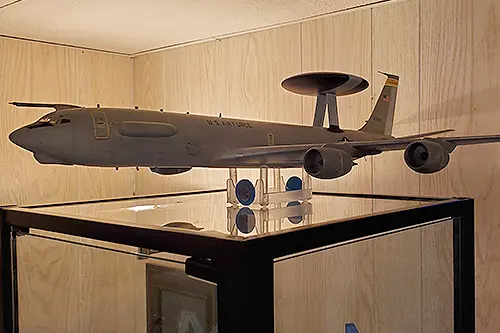
E-3 Sentry Airborne Warning And Control System (AWACS).
The E-3 Sentry is a modified Boeing 707/320 commercial airframe with a rotating radar dome. The dome is 30 feet (9.1 meters) in diameter, six feet (1.8 meters) thick, and is held 11 feet (3.33 meters) above the fuselage by two struts. It contains a radar subsystem that permits surveillance from the Earth’s surface up into the stratosphere, over land or water. The radar has a range of more than 250 miles (375.5 kilometers). The radar combined with an identification friend or foe, or IFF, subsystem can look down to detect, identify and track enemy and friendly low-flying aircraft by eliminating ground clutter returns that confuse other radar systems.
Major subsystems in the E-3 are avionics, navigation, communications, sensors (radar and passive detection) and identification tools (IFF/SIF). The mission suite includes consoles that display computer-processed data in graphic and tabular format on video screens. Mission crew members perform surveillance, identification, weapons control, battle management and communications functions.
The radar and computer subsystems on the E-3 Sentry can gather and present broad and detailed battlefield information. This includes position and tracking information on enemy aircraft and ships, and location and status of friendly aircraft and naval vessels. The information can be sent to major command and control centers in rear areas or aboard ships. In time of crisis, this data can also be forwarded to the president and secretary of defense.
In support of air-to-ground operations, the Sentry can provide direct information needed for interdiction, reconnaissance, airlift and close-air support for friendly ground forces. It can also provide information for commanders of air operations to gain and maintain control of the air battle.
As an air defense system, E-3s can detect, identify and track airborne enemy forces far from the boundaries of the United States or NATO countries. It can direct fighter-interceptor aircraft to these enemy targets. Experience has proven that the E-3 Sentry can respond quickly and effectively to a crisis and support worldwide military deployment operations.
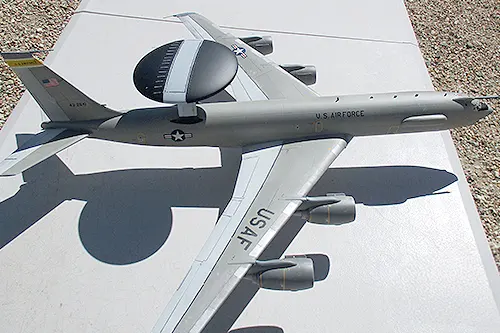
An overhead view of the E-3 Sentry highlights its distinctive radar dish, mounted above the fuselage. The aircraft is a modified version of the Boeing 707, adapted for airborne early warning and control operations.
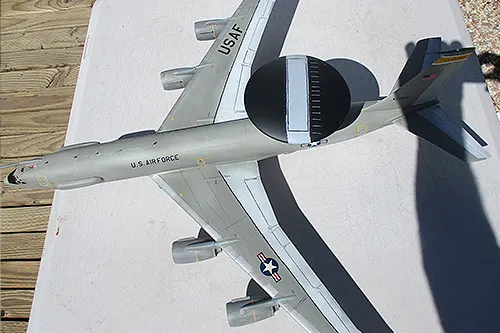
A top-down perspective of the E-3 Sentry model emphasizes the clean lines of the upper fuselage and the scale of the radar dome, offering a broader sense of the aircraft’s proportions and surface detailing.
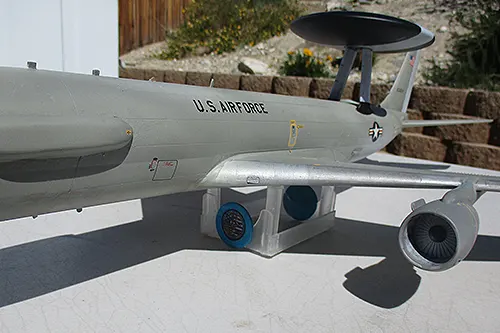
Note the side-looking antenna housings along the forward fuselage of the E-3 Sentry. These streamlined fairings contain electronic support and communications systems, reflecting the aircraft’s advanced airborne surveillance and command capabilities.
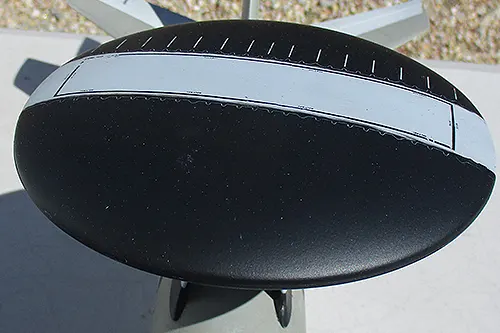
A close up look at the rotodome atop the E-3 Sentry. In reality this is a 30 foot diameter, 6 foot thick structure that rotates and houses the radar antenna for the AWACS.
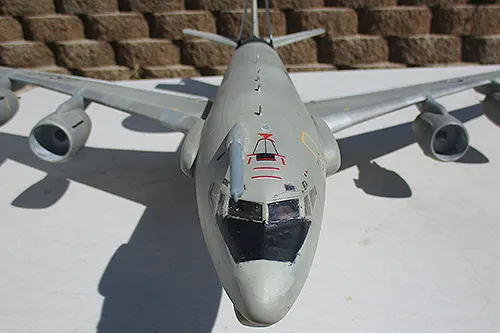
A head-on look at the E-3 Sentry. Notice the refueling probe atop the cockpit area. This is for the “Probe and Drogue” refueling system used by RAF and French variants of the aircraft. USAF versions have a door that a refueling probe plugs directly into from above the airplane. It is marked by the rounded triangular marking directly above the center of the cockpit. The client choose to display this model with both refueling variants.
Here we see the finished model of the E-3 Sentry proudly displayed by the client on top of his office display case.