This page features tall ship models built by Rich, each displayed on a custom base or stand, some of which allow for distinctive above and below viewing angles, highlighting the craftsmanship, detailing, and construction techniques used in each build.
Sea Witch
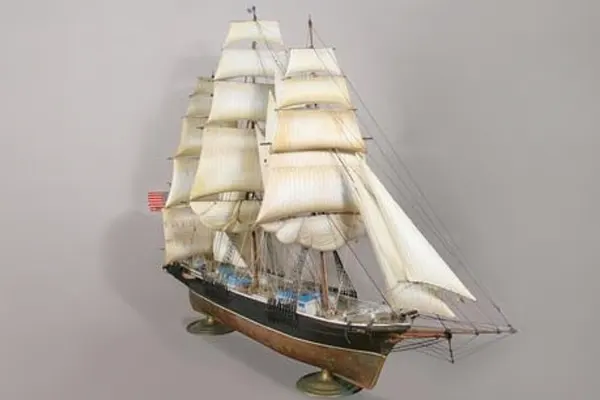
The Sea Witch was a famed American clipper ship launched in 1846 from the shipyard of Brown & Bell in New York. Designed for speed and efficiency, she was part of the “extreme clipper” era, when naval architects pushed hull forms to achieve the fastest possible passages for the China and tea trade routes. Under the command of Captain Robert “Bully” Waterman, she became one of the most celebrated fast ships of her time.
Her most famous voyage came in 1849, when she sailed from China to New York in just 74 days, setting a record for the passage that stood for many years. The Sea Witch’s sleek lines, towering rig, and large sail plan made her both a technological achievement and a symbol of American maritime ambition during the height of the clipper ship era.
Lindberg model kit build of the tall ship Sea Witch, depicting the fully rigged vessel with detailed masts, sails, and deck fittings.
Santa Maria
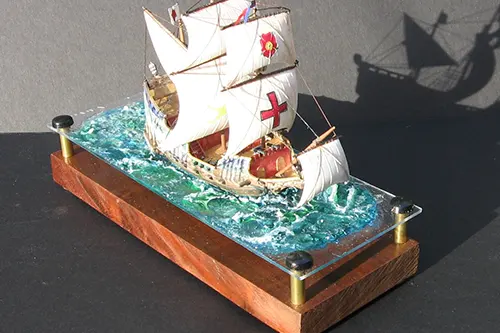
Handcrafted replica of the Santa Maria model ship displayed under full sail, featuring traditional Spanish cross details and mounted on a sculpted ocean base. This custom-built historical sailing ship represents Christopher Columbus’s 1492 flagship with finely detailed rigging and a dynamic maritime presentation.
Rich’s hand-crafted build of Christopher Columbus’s famed sailing ship the Santa Maria.
HMS Bounty
HMS Bounty was a small British merchant vessel purchased by the Royal Navy in 1787 for a botanical mission to the South Pacific. Commanded by Captain William Bligh, the ship was tasked with transporting breadfruit plants from Tahiti to the Caribbean to serve as a low-cost food source for enslaved laborers on British plantations. After a long and difficult voyage, the crew remained in Tahiti for several months, a stay that contributed to growing tensions aboard the ship.
In April 1789, shortly after departing Tahiti, Acting Lieutenant Fletcher Christian led a mutiny against Bligh. The captain and eighteen loyal crew members were set adrift in an open boat and remarkably navigated over 3,500 miles to safety. The mutineers returned to Tahiti, while Christian and a small group ultimately settled on the remote Pitcairn Island, where they burned the Bounty to avoid detection. The story of HMS Bounty has since become one of the most famous episodes in maritime history.
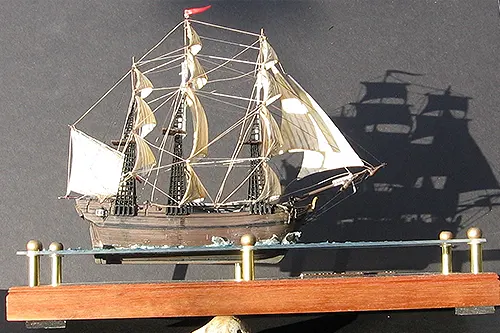
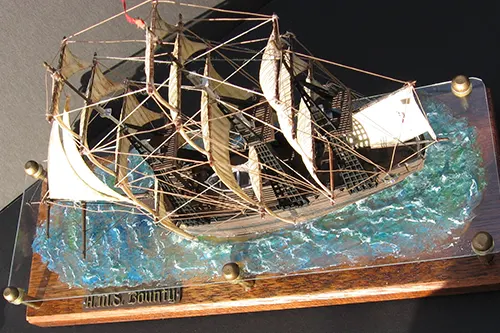
Profile shot of HMS Bounty under full sail.
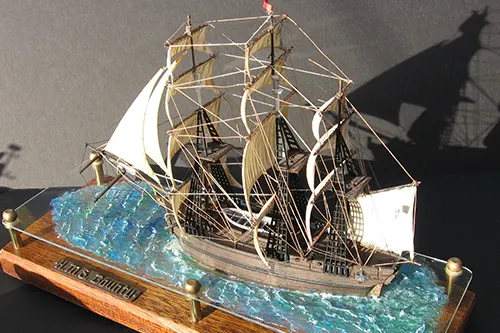
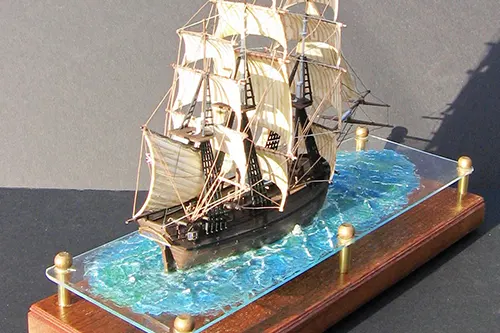
Handcrafted replica of HMS Bounty model ship under full sail, mounted on a detailed ocean base and representing the historic 1789 mutiny vessel.
A look down from above the HMS Bounty.
Here is a look at the HMS Bounty from the stern. This is a great example of one of the finest ships of her era.
19th Century Brigantine
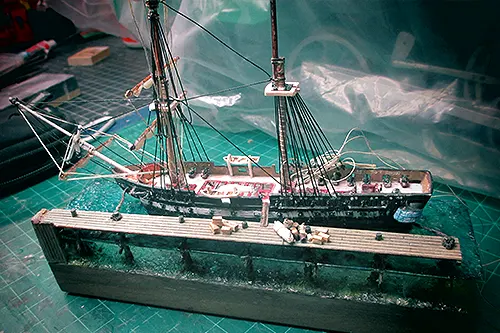
Handcrafted 19th-century brig model ship moored at a wooden pier, featuring detailed rigging, deck equipment, and a realistic harbor diorama base. This custom-built sailing ship model represents a traditional coastal trading vessel, with authentic nautical construction, miniature cargo elements, and a carefully finished waterfront scene designed for collectors and maritime displays.
Handcrafted model of a 19th century brigantine model shipp moored at a pier.
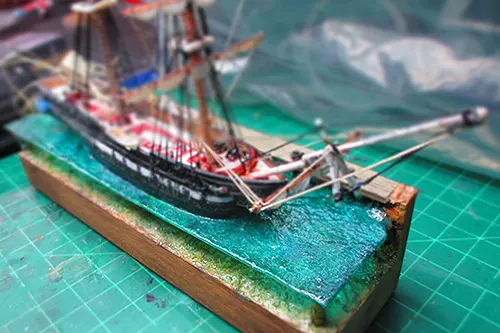
Front view of a handcrafted 19th-century brig model ship, highlighting the bowsprit rigging, detailed hull lines, and realistic harbor setting.
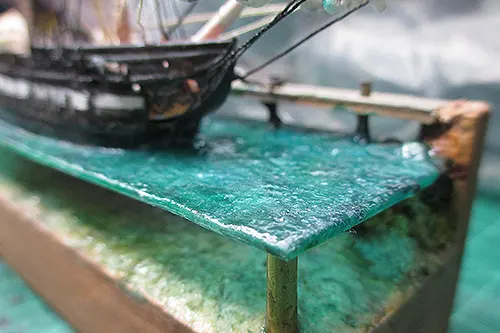
Close-up of the handcrafted ocean base, featuring detailed water effects and a realistic above- and below-waterline harbor scene.
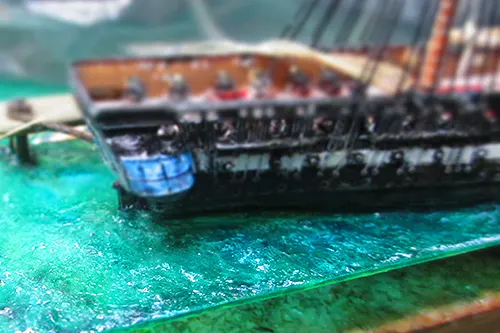
Aft profile of a 19th-century brig model ship, showcasing the stern structure, deck details, and finely crafted wooden hull.